How it works
From images to PDF, in three steps
- 01
Choose images
Drop any mix of PNG and JPG files in; each appears as a thumbnail in page order.
- 02
Arrange & set page size
Drag thumbnails to reorder, then pick fit-to-image, A4, or Letter.
- 03
Download PDF
Your PDF is assembled locally and downloads straight to your device.
To convert images to PDF, drop any mix of PNG and JPG files into the box above. There's no need to sort them by format first: the tool reads each file's actual content, not its file extension, to tell a PNG from a JPG, then handles each one the way it's supposed to be handled. Every file shows up as a thumbnail, in the exact order it'll become a page. Drag a thumbnail to move it, or use the arrow buttons if a drag isn't convenient.
Order and page size are two separate settings, and it helps to know how each one actually works. Order follows whatever sequence the thumbnails are in the moment you click Build PDF, nothing gets re-sorted afterward. Size comes from the page size option: Fit to image (the default) gives every page its own source image's exact pixel dimensions, so a document combining a tall phone photo with a wide screenshot ends up with pages of two different shapes, one per image. That's intentional, not a glitch. A4 and Letter instead force every page to one standard size, scaling each image down to fit inside it (never up, and never stretched out of its own proportions) and centering it, with an optional margin adding white space around the edges.
Neither format gets decoded and re-encoded along the way. A PNG's own bytes go straight into its page exactly as they were; a JPG's bytes go in the same way, at whatever compression the photo already had. That's also why a batch of five or six images builds in about a second: there's no image processing step, just reading files and assembling a document around them, in a background worker so the tab stays responsive the whole time.
When you need this
A mixed batch, one document
Real folders of images rarely stick to one format. A report with photographed evidence (JPG) and exported diagrams (PNG) shouldn't need two separate tools before you can combine them into a single PDF.
Photo and screenshot evidence together
Insurance claims, support tickets, and expense reports often mix camera photos with annotated screenshots. Drop both kinds in together and they land in one document, in whatever order tells the story clearly.
Submit a document as one file
Forms and portals asking for a single PDF upload don't care what format your source images started as, and this tool doesn't either.
Archive a project's images together
Screenshots, scans, and photos from one project are easier to keep, search, and hand off later as a single multi-page PDF than as a loose folder of mixed file types.
Worked example
Say you're preparing a quick product handoff: two PNG graphics and one JPG material photo, already in the order you want to share them. The three files total 5.2 MB.
Drop all three into the box above in any order, the tool doesn't care which format lands first. Drag them into the sequence the handoff should read in, select "Fit to image," and click "Build PDF." In a couple of seconds you'll have one three-page PDF. Because neither format gets re-encoded, the finished file stays close to its 5.2 MB source total; 5.9 MB is normal once the PDF container overhead is added.
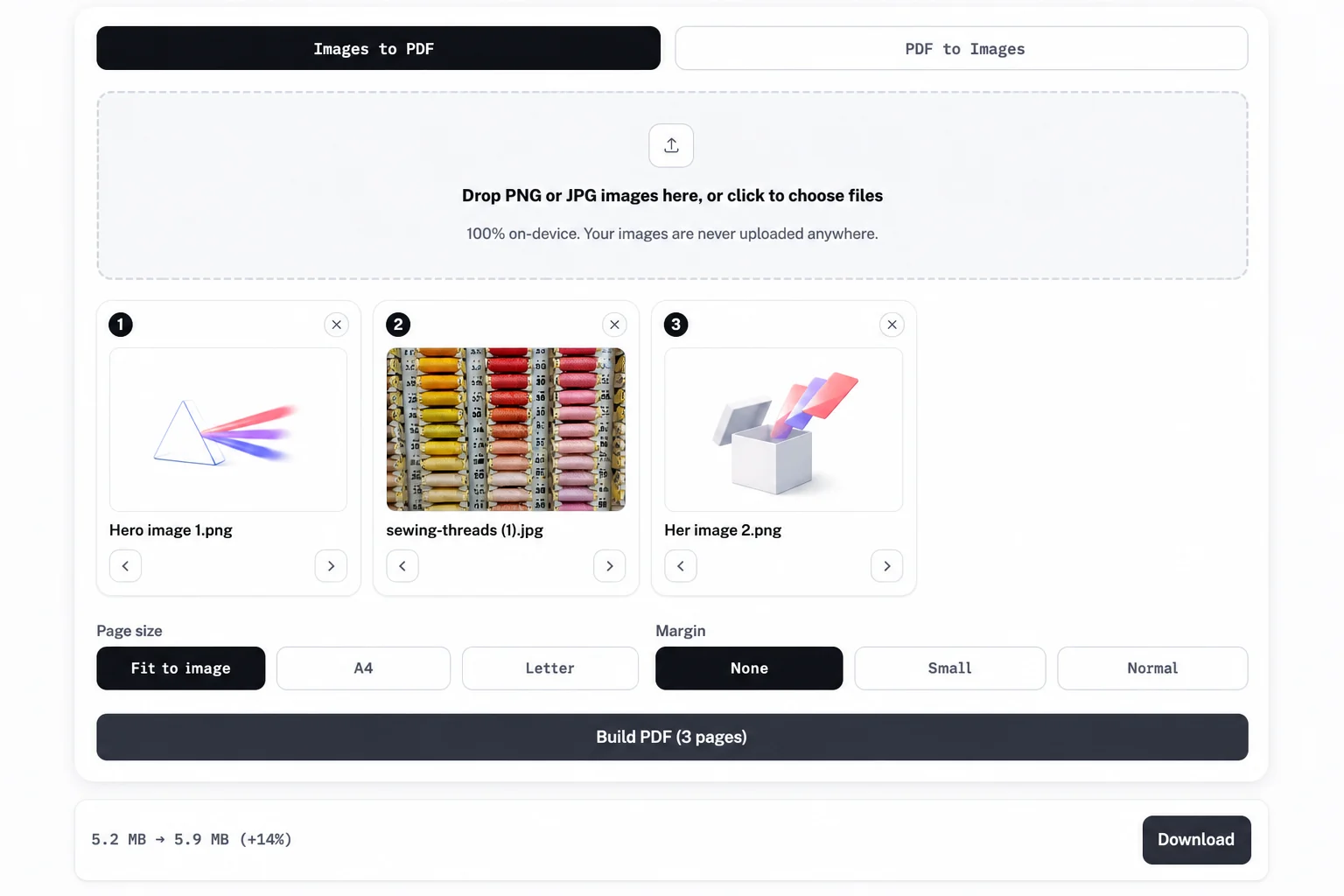
Want every page the same size instead, say for printing? Switch to A4 or Letter before you build, and each image, regardless of its original format, gets centered and scaled down to fit without distortion.
Format explainer
PDF is a document container, not an image format itself, which is exactly why it can hold a mix of PNG and JPG pages without any conflict. This tool detects each file's actual format from its bytes (not just its file extension) and embeds it accordingly: PNG bytes go in losslessly, JPG bytes go in at their original compression, with no re-encoding step for either one.
If your files happen to all be one format, the dedicated PNG to PDF or JPG to PDF converters do the exact same thing; this page exists for the more common real-world case where they're not. Going the other direction, turning PDF pages back into images, always outputs a single consistent format (PNG or JPG, your choice) rather than trying to guess back what each page originally was.
Frequently asked questions
Add your PNG or JPG files, arrange the thumbnails in page order, choose Fit to image, A4, or Letter, then select Build PDF. Your browser creates one PDF locally, ready to download.
Yes. You can combine PNG and JPG images into a PDF online for free, with no account and no upload to a server.
Yes. Drop any combination of PNG and JPG files, in any order, and they all go into one PDF, one image per page, each embedded in its own original format.
No. Each image is detected by its actual file content and embedded using its own original bytes, PNG losslessly, JPG at its existing compression, regardless of what else is in the batch.
It reads each file's own byte signature rather than trusting the file extension, so a renamed or mislabeled file is still handled correctly, or flagged if it isn't actually a valid image at all.
"Fit to image" (the default) gives each page its own image's exact dimensions, which usually looks best for a genuinely mixed set of photos and graphics. Pick A4 or Letter instead if every page needs to be the same standard size, for example for printing.
No. Reading the files, detecting their format, and assembling the PDF all happen locally in your browser, in a background worker. Nothing is sent to a server.
No limit set by the tool itself; a very large batch is bounded only by your device's own memory while the PDF is being built.
Related pages
- PNG to PDF converter
Use this instead if every file in your batch is already PNG.
- JPG to PDF converter
Use this instead if every file in your batch is already JPG.
- PDF to PNG converter
Use this instead when you need to go the other way, pulling lossless images back out of an existing PDF.
- PDF to JPG converter
Use this instead to pull images back out of a PDF as smaller, compressed JPGs.
- HEIC to PDF converter
Use this instead if your images are iPhone HEIC photos rather than PNG or JPG files.